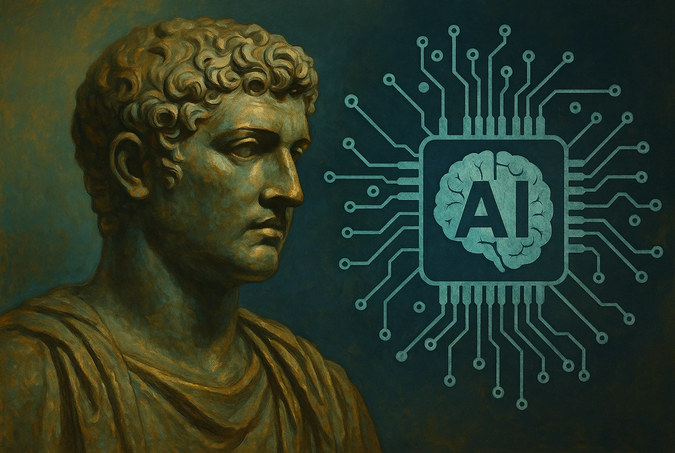
Why didn’t the Romans mechanise their fields with water wheels or the Egyptians roll their stones on wheels instead of dragging them? History points to economics: labour was cheap. With slaves, serfs, and vast conscripted workforces, there was little incentive to replace human effort with machines.
History suggests that technological adoption is not simply a function of what is possible, but of what is economically necessary.
Fast forward to today. We live in a world where labour is expensive – at least in advanced economies. Hiring talent is costly, regulations surrounding human resources are strict, and demographic trends indicate a shrinking working-age population in many countries. Unlike the Romans, we do not have limitless human labour.
Enter AI.
From Empires to Enterprises
History is littered with examples of innovation stagnating when labour was abundant. (Perhaps unsurprisingly, given humans’ innate aversion to change and the disincentive for the ruling ‘elite’ of any age to implement change lest they lose control.
- Ancient Egypt: They had the wheel, but they didn’t use it to build pyramids because dragging stones with cheap, abundant manpower was simply more “cost-effective.” The innovation was available, but the incentive wasn’t.
- Roman Empire: Romans knew about water power, yet grain was still ground by hand on a massive scale. A water mill could displace hundreds of slaves. But why build it when labour was plentiful and cheap?
- China: China discovered gunpowder centuries before Europe, but didn’t weaponise it as fast as building labour-intensive armies was easy and viable.
- The Ottoman Empire: Failed to adopt the printing press as widely as Europe, as scribes where cheep and cultural barriers delayed its adoption.
- Mesopotamia: Had the arch, but didn’t realise its full potential, using it only in small buildings like tombs, because labour (slaves) was cheap and projects were small. (The Romans, by contrast, despite equally abundant labour, faced massive infrastructure demands across an expansive empire, requiring efficiency. This need for solutions above the capacity of the labour available drove innovation, with the arch becoming the keystone (literally and figuratively) of Roman engineering – aqueducts, bridges, the colosseum and the Pantheon domes symbolic of their power.)
Industrial Revolutions
Contrast all this with 18th-century Britain, where wages were high and coal was abundant. Suddenly, the steam engine wasn’t just a curiosity; it was an economic imperative.
There are countless other examples of the same: During the black death labour shortages raised wages and spurred the adoption of windmils, ploughs and crop innovations; In post world war two Japan and Germany’s need to rebuild with scarce labour drove automation and efficiency; and more recently in the 20th centuary the high costs of rural labour accelearte the mechanisation of agriculture in the US and Europe.
The parallel is striking: when labour is expensive, technology adoption accelerates. Constraint, not comfort, drives progress.
The Age of AI
Today, organisations face a similar inflexion point. Labour costs are rising. Margins are thin. Skilled people are hard to find and harder to retain. AI has moved beyond theoretical potential into practical utility: automating routine tasks, augmenting creative work, and offering scale and productivity previously unimaginable.
Just as the Romans could have mechanised but didn’t need to, modern enterprises must embrace AI – or risk obsolescence.
Learnings and Considerations for AI Adoption
- Necessity Drives Adoption: Just as high wages and resource constraints spurred the Industrial Revolution, rising labour costs will accelerate AI integration. Leaders must accept this inevitability.
- Technology Is Not Enough: The Romans had the water wheel, the Egyptians had the wheel. We have AI. Success depends not on invention alone, but on embedding and scaling it within real workflows.
- Cultural Alignment Matters: Slavery shaped Roman economics; today, company culture shapes AI adoption. A workforce that feels displaced rather than empowered by AI will resist, just as serfdom delayed European mechanisation.
- Ethics and Stability: Empires that leaned too hard on fragile economic models (slavery, tribute) eventually collapsed. Over-reliance on AI without considering resilience, ethics, and human value risks the same fate. A huge amount of empathy from leaders is going to be required to navigate this change in a way that is beneficial across societies.
- Opportunity for Visionaries: Britain in the 18th century used technology to leapfrog rivals. The organisations that thoughtfully embed AI today will define tomorrow’s competitive landscape.
Closing Thought
History is clear: when labour is cheap, innovation stalls. When labour is expensive, innovation accelerates.
Today’s economics demands AI adoption. The question is whether we will be Romans ignoring the water wheel, or entrepreneurs harnessing the steam engine.
The future belongs to those who choose the latter.
Footnote: We have AI, it is no longer speculative. It’s a tool to reclaim margin, raise efficiency, facilitate scale, and remove barriers to entry. Just as the Romans didn’t need the water wheel, many enterprises today do not yet need AI… until the moment they do.