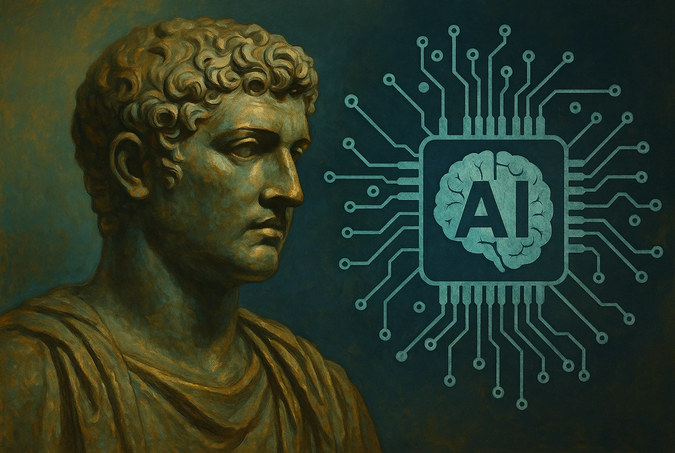
We have AI. The question is whether we will be Romans ignoring the water wheel or entrepreneurs harnessing the steam engine.

Why didn’t the Romans mechanise their fields with water wheels or the Egyptians roll their stones on wheels instead of dragging them? History points to economics: labour was cheap. With slaves, serfs, and vast conscripted workforces, there was little incentive to replace human effort with machines. History suggests that technological adoption is not simply a function of what is possible, but of what is economically necessary. Fast forward to today. We live in a world where labour is expensive – at least in advanced economies. Hiring talent is costly, regulations surrounding human resources are strict, and demographic trends indicate a shrinking working-age population in many countries. Unlike the Romans, we do not have limitless human labour. Enter AI. From Empires to Enterprises History is littered with examples of innovation stagnating when labour was abundant. (Perhaps unsurprisingly, given humans’ innate aversion to change and the disincentive for the ruling ‘elite’ of any age to implement change lest they lose control. Ancient Egypt: They had the wheel, but they didn’t use it to build pyramids because dragging stones with cheap, abundant manpower was simply more “cost-effective.” The innovation was available, but the incentive wasn’t. Roman Empire: Romans knew about water power, yet grain was still ground by hand on a massive scale. A water mill could displace hundreds of slaves. But why build it when labour was plentiful and cheap? China: China discovered gunpowder centuries before Europe, but didn’t weaponise it as fast as building labour-intensive armies was easy and viable. The Ottoman Empire: Failed to adopt the printing press as widely as Europe, as scribes where cheep and cultural barriers delayed its adoption. Mesopotamia: Had the arch, but didn’t realise its full potential, using it only in small buildings like tombs, because labour (slaves) was cheap and projects were small.  (The Romans, by contrast, despite equally abundant labour, faced massive infrastructure demands across an expansive empire, requiring efficiency. This need for solutions above the capacity of…

Is a machines ability to understand emotion blocked only by the lack of appropriate data ‘inputs’ to our models?  Or is there an ethereal quality to personality that’s uniquely human?

Photo by Mulyadi on Unsplash

In the rapidly advancing world of artificial intelligence, one challenge stands tall: the quest for machines to truly understand and express human emotions, and in so doing both read and create personalities – to move from the mimic to the relatable. This challenge – the current lack in depth of interaction between humans and machines – signifies the gap between the currently limited (if impressive) AI, and the ultimate goal of achieving Artificial General Intelligence (AGI). Emotion: More Than Just Data One of the primary hurdles for AI in understanding emotions is the intrinsically nuanced nature of emotions themselves. While AI excels at processing vast amounts of data and recognising patterns, emotions are not just data points. They are complex, multidimensional, and deeply intertwined with human experiences, memories, and culture. They often appear fickle on the surface, but really deep underling beliefs. Unlike a mathematical problem, there’s no definitive solution to understanding or expressing an emotion.   It’s an increasingly accepted preemies that the human brain works as a predictive tool, but importantly a tool with the ability to rapidly create new neural pathways when reality doesn’t meet our predictions.  We have the ability not just to predict, but to continually update our model. The prevailing neural network models strive to replicate this prediction approach, but, they overlook one key element: the unique influence of mirror neurones in a humans brain.  It’s mirror neurones that enable us to recognise, and empathise with, a reaction observed in others, by drawing from our past experiences.  This is what makes us human and allows us to form relationship. It build our personalities and is a evolutionary output of our social natures. And importantly it’s far, far more nuanced than current models can replicate, however large they grow. Real-time Interaction: The Empathy Gap When it comes to real-time human interactions, the absence of genuine empathy in AI becomes glaringly evident.  Imagine a doctor, delivering a life altering diagnosis to a patient: In such…

We have the propensity for boredom – the greatest sign of intelligence.

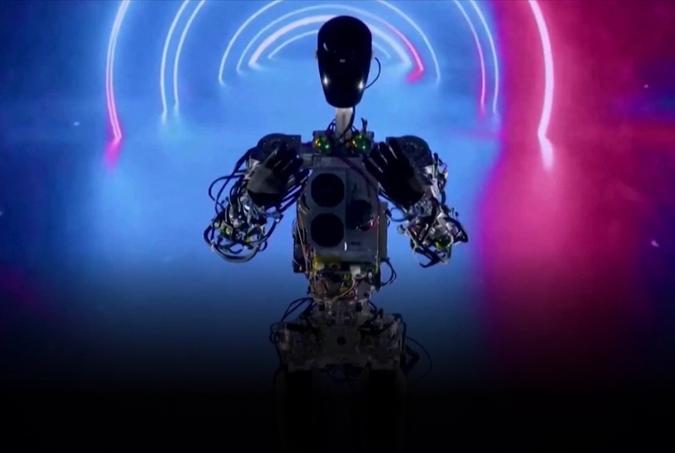
Today Elon Musk unveiled to much fan-fair the latest iteration of Teslas ‘humanoid’ robot, Optimus.  They’ll be mass produced, cost less than $20,000 each and be available in 3 – 5 years.  Not a small feet, and I want one. The rhetoric was nothing outside of the normal: “A future of abundance”, “a fundamental transformation of civilisation as we know it” and “a society in which robots [do] the work and people reaped the benefits “. That robots and AI will become ever more abundant, and will change civilisation as we know it, I think is beyond doubt.  But the important question remains:  Will this be the utopian dream Musk proclaims, or follow the dystopian nightmares beloved by Hollywood? For years there has been much talk about the impact of robots taking jobs. It’s a well trodden debate about skills, training and the ability to lift the repetitive, sometimes lower-skilled, workforce into the service economy.  For me though the question is deeper.  In a world where robots and AI do much of work and we ‘reap the benefits’ will we really be happier?  And will this really level society or does it risk increasing the already gaping divide between the top and the bottom of the economic food chain? Emotions Do you really want to live in a world where machines do all the work? As humans we are driven by the innate and fundamental impulses, baked into our primeval ‘old’ brain – Protection, nutrition, procreation (and as a subset social status).  But what separates us from animals is our ‘new’ brain – the neocortex – our intelligence. It’s this intelligence that created money as a way of measuring worth.  It’s this intelligence that drives our complex hierarchies of social status – measured through social cohesion, original thought, innovation and emotional empathy, with money often used as the proxy measure for these.  Where an animal would fight it out to find who’s top dog, we measure our status with these…